
Last year I had the opportunity to edit the Wikipedia page on Biblical paraphrase, which was an excellent introduction into my current project on Book of Mormon retellings by women. Retelling Bible stories is something people have been doing as long as the Bible has been around (it even occurs within the Bible). One thing that fascinates me about these retellings, whether they go verse-for-verse or for more of a summary, is that no one expected them to be “pure” or “literal.” If there was translating or paraphrasing going on, it was given that there would be interpretive work happening. Rikvah Zim explains it in his classic English Metrical Psalms:
…since the paraphrast was not obliged to preserve the author’s meaning in the author’s words, a paraphrase could not carry that degree of authority which was held by the best translation or literal interpretation. By adopting paraphrase as his method of imitation a writer acknowledged that he was not presenting the original text, nor claiming to reproduce it.1
The same applies to retellings of Book of Mormon stories, or even stories set in Book of Mormon times. We understand that it’s a work separate from the original text. And any time someone changes the medium of a text (language, genre, etc.), interpretation will occur. So it’s not surprising to me that when anyone retells a Book of Mormon story, they are also engaged in interpretive work.
Why would women think they had a right to interpret scripture? At the founding of the Relief Society, Joseph Smith read over D&C 25 again, and said that the part where she was blessed to “expound the scriptures to all” applied not just to her, but to the rest of the women in the Relief Society. Here’s the quote from the Nauvoo Minute Book:
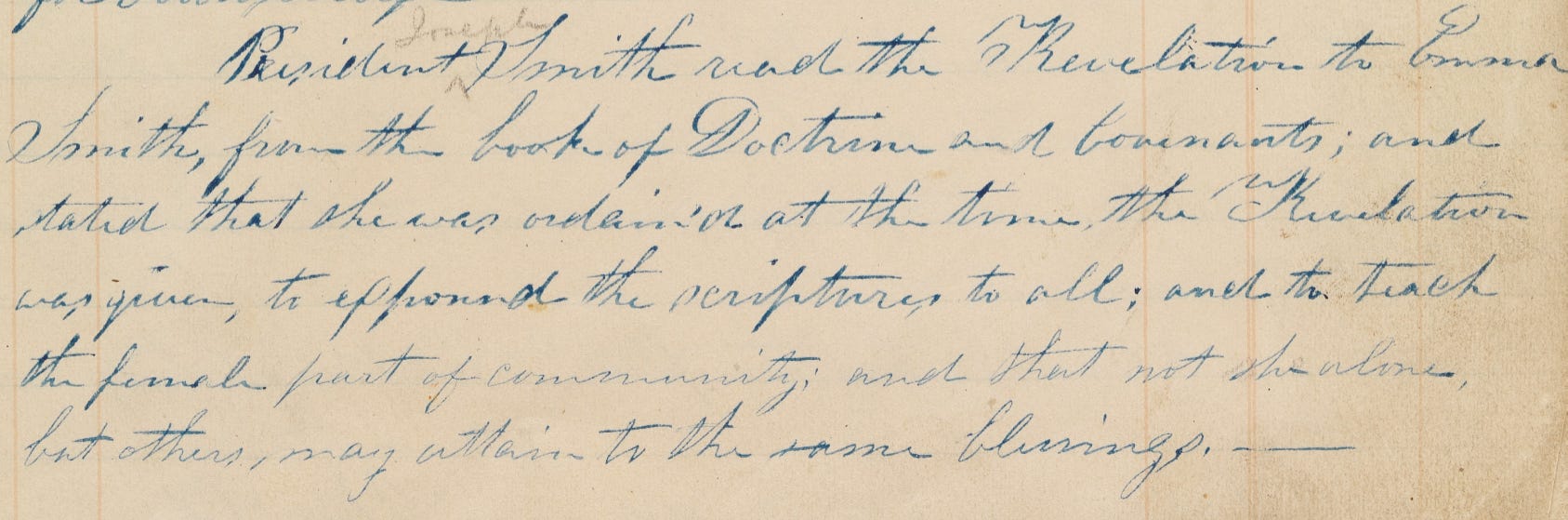
President Smith read the Revelation to Emma Smith [D&C 25], from the book of Doctrine and Covenants; and stated that she was ordain’d at the time, the Revelation was given, to expound the scriptures to all; and to teach the female part of community; and that not she alone, but others, may attain to the same blessings.2
It’s… actually really difficult to find women’s interpretations of the Book of Mormon. Amy Easton-Flake’s chapter on Mormon women and scripture discusses how Mormon women mostly cited scripture to help with moral instruction. They didn’t pontificate about doctrine.
with the one prominent exception of polygamy, articles and scriptures devoted to explaining these unique Church doctrines appear only sporadically in the writings of Mormon women but proliferate in the publications of Mormon men. To say that women did not write about the doctrines that distinguish Mormons would be inaccurate, as scriptures on baptism, apostasy, and restoration appear a handful of times in their writings, while scriptures on the need for priesthood, proper authority, prophets, and continual revelation make a more frequent appearance. However, the vast statistical discrepancy between occurrences in the Millennial Star and the Woman’s Exponent indicates that this was not a central function of women’s scriptural engagement.3
That’s why when women’s ideas about doctrinal interpretation of the Book of Mormon do show up, I’m very interested in them!
Zim, Rivkah. English Metrical Psalms: Poetry as Praise and Prayer, 1535–1601. Cambridge University Press, 2010.
Transcript from The First Fifty Years, web version. I found it through Flake, Kathleen. “Ordering Antinomy: An Analysis of Early Mormonism’s Priestly Offices, Councils, and Kinship.” Religion and American Culture 26, no. 2 (2016): 139–83. 2018300820. https://doi.org/10.1525/rac.2016.26.2.139.
Easton-Flake, Amy. “Mormon Women and Scripture in the Nineteenth Century.” In The Routledge Handbook of Mormonism and Gender, edited by Taylor Petrey and Amy Hoyt. Routledge, 2022.