
Here’s part of my presentation from the Book of Mormon Association conference, which was earlier this month. I think this excerpt makes okay sense, plus I promised to do some close reading of Merkley’s work, so here it is!
Scene-within-a-scene in a Book of Mormon retelling
Heloise Day Merkley uses the scene-within-a-scene tool in Lure of the Homeland (1921-1922) to further teach the purpose of Book of Mormon stories in her work--a compelling technique modeled by the Book of Mormon itself. Joseph Spencer noticed that King Mosiah reads the record of Zeniff to his people, a record which itself is a text in the Book of Mormon. He described this as a “subtler” mise en abyme, or an instance where the work of art itself appears in the work of art.1 In Merkley’s work we see a didactic retelling of scripture within a didactic retelling of scripture. The technique “gives a work of art a kind of self-consciousness, a reflexivity that allows it to say something to the viewer about what the thing is supposed to mean,” to use Spencer’s description of Book of Mormon mise en abyme. It tells us how Merkley wants us to interpret her work.
In Merkley’s serialized novel, The Lure of the Homeland she imagines an elaborate backstory for Zeniff, the father of wicked King Noah and the author of the record that constitutes the 9th and 10th chapters of the Book of Mosiah. Merkley’s Zeniff grows up in the city of Nephi and meets Mosiah and Mosiah’s people in the wilderness by chance. While he is gone, his love interest, Velma, marries someone else. Zeniff returns to Mosiah’s people, and scouts Zerahemla for them, learning the language of Zarahemla, which is different from his own. He successfully negotiates for Mosiah’s people to join Zarahemla’s, and convinces Ammon to stop a plot to make Ammon king. He marries Mosiah’s daughter Remalia, and eventually grows to love her, even though for a long time, he pined for Velma. After his wife bears two children, Noah and Velma, she dies. Zeniff is consumed with a desire to return to the land of Nephi to see what has become of Velma after his wife dies. Zeniff leads a band of Nephites partway there, but they disagree about whether or not they should fight with the Lamanites. Zeniff sees good in the Lamanites and is against attacking them. After returning to Zarahemla, Zeniff tries again to find the land of Nephi, this time accompanied by women and children. Zeniff convinces King Laman to let him and the people he brought live in the land of Nephi. In the end, he sees his daughter Velma falling in love with Velma’s son.
The Lure of the Homeland contains a Book of Mormon retelling within a Book of Mormon retelling, which gives us insight into how Merkley believes retellings can function. The story-within-a-story shows Merkley’s idea of how scripture ought to be interpreted and applied to daily life.
The protagonist of “The Lure of the Homeland” is Zeniff. After negotiating for Mosiah to become the ruler of Zarahemla, Zeniff reads the story of Coriantumr. Coriantumr’s story comes from the Book of Ether, which is a record that Zarahemla gave to Mosiah to translate when their peoples combined. In the Book of Mormon, Zeniff likely was alive during the time that the Book of Ether was translated, and could have read it before making his own record (the Record of Zeniff). Merkley’s attention to the timeline of Coriantumr’s story coming to light indicates her excellent comprehension of the Book of Mormon. Zeniff uses the Book of Ether in two ways: with the story of Coriantumr, as an example of how not to rule, and with the existence of the text, as inspiration to create his own record.
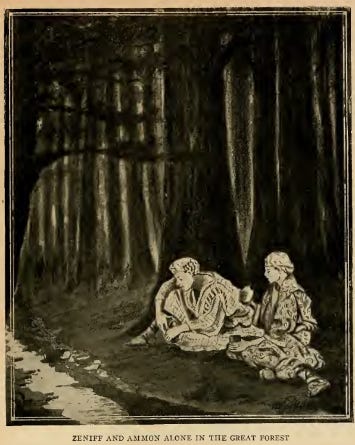
Zeniff is exploring a nearby forest with Ammon, teaching him scouting skills. As they converse, Ammon reveals that there is a plot to murder Zarahemla, Mosiah, Benjamin, and others to put himself on the throne. Zeniff is alarmed, but decides not to tell Ammon his thoughts directly. Instead, he tells him the story of Coriantumr, a “tragedy” of a “mighty king whose ambition and selfish wickedness had wrought the destruction of a mighty race of people.” He described Coriantumr’s loneliness “as he wandered over the desolate wastes that had once been fair cities and fruitful fields.” Zeniff warns Ammon that acting selfishly will lead to the downfall of his people, using Coriantumr as a negative example--of what not to do as a ruler. Zeniff and Ammon are living on the Jaredites’ former land and inheriting their record long after their death. The extinct race’s history becomes moral instruction for the people now occupying their land.
The way Zeniff uses the story is important as well. Through telling the story of Coriantumr, Zeniff is able to tell Ammon about “the mission of Christ and his message of peace and brotherly love,” but “he carefully avoided seeming to preach.” Instead of preaching, Zeniff made his message “a story” and filled it with all the things that he knew would appeal to the boyish imagination of his companion, and Ammon was quick to see and discuss points of doctrine that had a bearing on his own life.” The Lure of the Homeland contains many elements that could appeal to adolescents--difficulties in love, starting a new life in a new city, and frightening encounters with wildlife predators. Through the story-within-a-story, Merkley shows us both her own conception of the way that scripture stories teach, and how she has enacted that conception through retelling a scripture story.
Idleness = Wickedness?
One pervasive theme in Lure of the Homeland is that idle people are wicked. In Coriantumr’s story, the idleness has already turned to wars and desolation. Merkley’s text describes them as “desolate wastes that had once been fair cities and fruitful fields.” This parallels Zeniff’s observations of the Land of Nephi when he returns to them: “The streets were littered with refuse, houses were slowly falling into ruins, and everywhere was the sign of idleness and dirt. Evidences of habitation were common enough, but it was not the industrious occupation they had expected to see.” (p. 185 April 1922) Elise Boxer wrote that in Mormon settler colonialism, “Indigenous peoples were simply other settlers who could be displaced by righteous, white settlers. Indigenous people’s uncivilized ways paved the way for settler claims and the (re)making of land tied to Mormon whiteness.”2 The Lamanite neglect of the city makes Zeniff’s return feel justified.
Merkley’s story teaches us to read the frame story as another negative example of a ruler (i.e., Zeniff). In Zeniff’s story, Zeniff learns to despise idleness. His father is called “white handed” “for his skill in avoiding all semblance of physical labor.” After Velma ends up with another guy, Zeniff returns to Mosiah’s people in the wilderness. Zeniff explains why he was unhappy with his own people:
there is joy in the consciousness of some useful work well done that is far better than the satisfaction of a leisure that is aimless and unprofitable. . .The sense of worth that follows real service is far greater than the cost of the effort to achieve it. After tasting the sweetness of labor that did some good in the world and helped someone beside myself, this idleness and waste of energy is like a diet of bread and water after the richest foods have become habitual. (ch. iii Jan 1922 pg. 12)
Remalia, Zeniff’s future wife, also sings about the importance of hard work:
“O, hear how the birds are singing
Sweet Carols to the sun!
While hope in our hearts up springing
Cries, “work ‘til the prize is won.”
Though our burdens now are grievous
And our travels endless seem
There is One who will not leave us
While we work and wait and dream.” (Feb 1922 p. 68)
Industry is a virtue, but it also makes Nephites a target for Lamanite violence. Young Abinadi, without knowing Zeniff’s identity, tells him that King Zeniff has acted foolishly, for multiple reasons. On the topic of idleness, Young Abinadi says the peace with the Lamanites will only last until the Nephites “by their industry have acquired enough wealth and worldly goods to make valuable spoil for their idle foes. Until Laman decides that he is strong enough and they are desirable enough so that he can profitably attempt to conquer them.” (May 1922 ch X, 240). The division between idleness and industry is what makes the Nephites an attractive target of violence from the Lamanites.
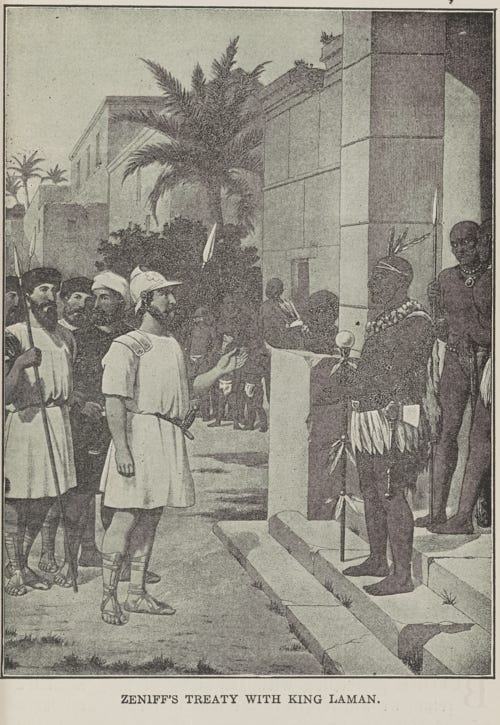
Zeniff’s love of industry is not yet a problem in the novel. His great sin is returning to his homeland, the land of Nephi. Young Abinadi tells him that King Zeniff has acted foolishly, because he neglected “the principles that made Mosiah so wise a ruler” (Ch X: May 1922, 239):
“He has effected no religious organization among his people,” answered the young man, “and he should know from his own experience, as well as from the experience of our race, that without religious effort and spirit we can not hope to reach great heights that without righteousness a people die.”
Young Abinadi continues that King Zeniff’s greatest sin was bringing the people of Zarahemla back to Lehi-Nephi. He says, “The Lord had led us out of this land, and his wisdom decreed that the Nephites should remain separated from their brothers. Only stubborn self-will and lack of faith in divine wisdom could have led anyone to return.” Young Abinadi reprimands Zeniff for returning to the land the Lord had led him out of.
Merkley writes about one of the few stories where ultimately, the Nephites don’t get their land back. Predictably, it’s because they were wicked. But it’s also because Zeniff makes an agreement with a crafty man (the king), and his people live alongside the Lamanites, giving the Lamanites proximity and opportunity to attack at any time. Merkley shows that the Lamanite position is to punish Nephites for disobeying God.
Spencer, Joseph. “‘Struck with Wonder and Amazement’: Reading the Book of Mosiah with Mormon.” The Wonder of Scripture. November 8, 2024. https://mi.byu.edu/joseph-spencer-wonder-of-scripture.
Boxer, Elise. “The Book of Mormon as Mormon Settler Colonialism.” In Essays on American Indian and Mormon History, edited by P. Jane Hafen and Brenden W. Rensink. University of Utah Press, 2019, 61.
She wrote a novel!